
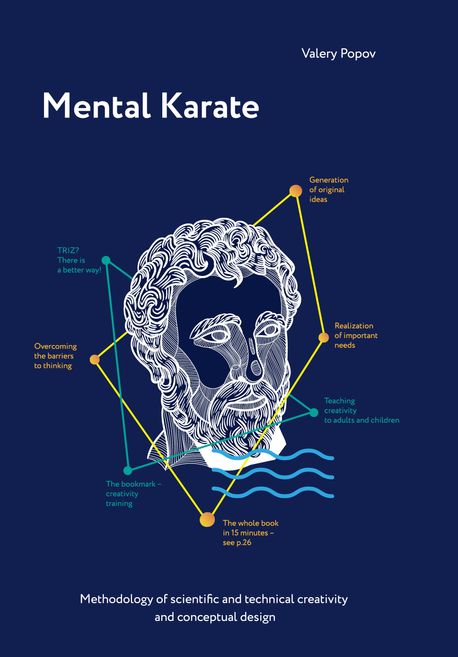
“창의력도 단련할 수 있다! 곧 정신의 무술이다.”
도서출판 뿌쉬낀하우스는 러시아의 발명가이자 창의 교육의 대가 발레리 V. 포포프(Valeriy V. Popov) 의 대표 저작 『멘탈 가라테: 과학기술 창의성과 개념설계 방법론』의 영문판(제4판)을 출간한다.
기술 변화가 가속화되는 오늘날, 포포프의 《멘탈 가라테》는 인간 중심적이면서도 실질적인 창의력 훈련 시스템을 제안한다. 그는 창의성을 무작위적인 ‘영감’이 아닌, 훈련 가능한 지적 기술로 정의하며, 이를 ‘정신의 가라테’라는 상징적 명칭으로 풀어낸다.
TRIZ(창의적 문제해결 이론)의 한계를 넘어서, 이 책은 심리학·시스템 사고·수사학·교육학을 아우르는 현대적 방법론으로, 복잡한 문제를 해결하고 새로운 아이디어를 설계하는 ‘창의적 전투법’을 소개한다.
이 책의 특징은 기존의 TRIZ 이론을 뛰어넘는 직관적이고 체계적인 설계방법론을 제시한다는 것인데, 저자는 이것을 8단계 휴리스틱 기법이라 칭한다. 8단계의 개념설계 프로세스를 통해 다양한 분야에서 창의적 사고로부터 만족할 만한 결과물을 도출해 내는 훈련을 한다.
발레리 포포프는 러시아연방 공훈발명가로서 채굴, 에너지, 구조공학, 의료기술 등 다양한 분야의 100건 이상의 특허를 보유하고 있으며, 수십 년간 발명 및 교육 경험을 바탕으로 창의력 교육을 이끌어왔다. 이번 영문판은 전문 번역가 알렉세이 넬류보프에 의해 완성되었다.
Mental Karate is a groundbreaking exploration into the nature of creativity, design thinking, and technological innovation. Building upon and critically expanding beyond the classic TRIZ methodology, this book presents an integrated system of ‘conceptual design’ rooted in human needs and powered by ‘heuristics’-the strategic techniques of mental discovery.
Valery Popov, a decorated Russian inventor, offers a comprehensive methodology that transforms creativity from a mysterious gift into a learnable and trainable skill. Drawing on decades of practical invention across multiple industries, the author distills creativity into eight distinct stages of conceptual design, each supported by heuristic tools that act like the techniques of martial arts-a “mental karate” for innovators.
책 속으로
“This book is about weaponizing creative thinking. Once you have a weapon, you engage in battle-and through battle, you transform both yourself and the world.”- p.8
“Creative thinking means constructing a structure of thought.”- p.10
“Originality is often nothing more than disguised cliché.”- p.11
“Conceptual design is a creative thought process that derives technological systems from human needs.”- p.13
“A heuristic is a kind of psychological weapon that triggers creative thinking. But without proper training, even a weapon becomes dangerous.”- p.17
“Creative thinking is a mental martial art-a fight against errors.”- p.21
“TRIZ fails to train the muscles of creativity. It is overly dogmatic and cannot truly mechanize creative thought.”- p.24
“Good design is not merely technical-it is philosophical and profoundly human.”- p.32
“Technological systems evolve toward doing more with fewer resources.”- p.49
“Mental Karate is the psychological martial art of training one’s creative weapon and sharpening one’s sense for conceptual design.”- p.62
출판사 서평
Mental Karate: Methodology of Scientific and Technical Creativity and Conceptual Design is a groundbreaking contribution to the evolving field of creative problem-solving and innovation management. Rooted in decades of invention and design experience, this book by Valery V. Popov offers a compelling alternative-and thoughtful evolution-of the widely known TRIZ (Theory of Inventive Problem Solving).
Where TRIZ focuses heavily on formalized tools and contradiction-based resolution algorithms, Mental Karate proposes a more systemic, human-centered, and heuristic-driven methodology. The author recognizes the foundational value of TRIZ but critiques its conceptual vagueness, scientific inconsistencies, and limited educational accessibility. In response, he builds an integrated design framework that is not only technically rigorous but pedagogically intuitive.
At the heart of this book lies the 8-stage model of conceptual design-a methodical process that guides innovators from the identification of broad human needs to the development, refinement, and optimization of technical solutions. These stages include:
1. General human needs
2. Individual needs
3. Functional requirements
4. Consumer properties
5. Functional structure
6. Operating principles
7. Technical solution formation
8. Optimization of parameters
This model presents creativity not as an unpredictable spark, but as a trainable intellectual discipline-much like a martial art. Hence the name Mental Karate: a mental combat system of design thinking built upon strategic heuristics, not random intuition.
Popov’s approach is deeply interdisciplinary. It draws from systems engineering, philosophy, psychology, and even classical rhetoric. His use of heuristic techniques-such as the “ascent-descent” method, metaphor-driven ideation, and the classification of “good” and “bad” verbs and adjectives-translates into real-world tools that readers can apply not only in engineering and design, but in business, education, and personal decision-making.
This book is ideally suited for:
– Engineers, product designers, and inventors
– TRIZ practitioners seeking to broaden their methodology
– Educators and trainers in creativity and innovation
– Students of design thinking, systems science, and entrepreneurship
– Anyone interested in developing structured creative skills that are applicable in both professional and everyday life
Mental Karate challenges the myth of “innate genius” and instead empowers all readers-regardless of background-to engage with creativity as a practical, accessible, and even joyful activity. With clarity, depth, and vision, Popov delivers not only a new methodology but a new mindset for a complex, innovation-driven world.



Reviews
There are no reviews yet.